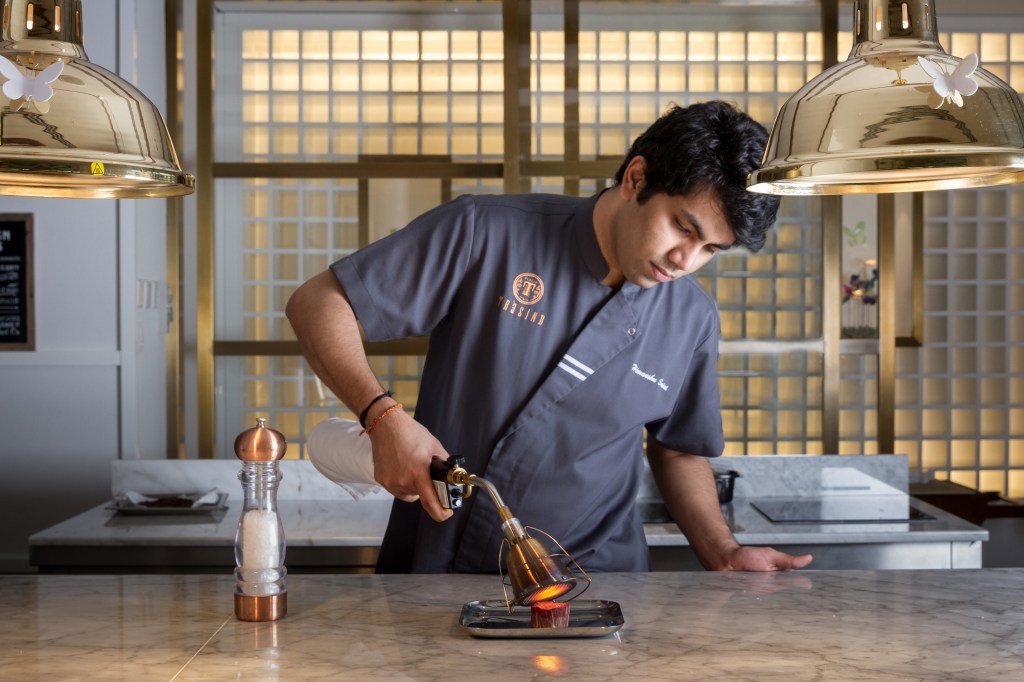
“What’s the best restaurant in Dubai?” For anyone involved in the city’s food scene, this is far and away the question you get asked most often. Luckily, for the last six years, I’ve had an answer chambered and ready to go: Tresind Studio.
It’s not a groundbreaking opinion, in fact, nowadays it’s a pretty basic bitch one (“Like all of your opinions, Simon” – Fantastic, good one, reader). After all, Tresind Studio, a 20+ course tasting menu restaurant from hospitality group Passion F&B, has two Michelin Stars, was ranked second in the World’s 50 Best Restaurants MENA list 2024, and 13th in the global list. Of course, both the Michelin Guide and The World’s 50 Best have some serious question marks about their selection processes, not least because Pickl is yet to be picked up by either.
Tresind Studio launched at the end of September 2018, and just a month prior, I interviewed the culinary genius behind it, Himanshu Saini, in my former gig as editor of Caterer Middle East. I’d only been in Dubai for two months at the time, but I was already excited by Himanshu’s gastronomic talents after dining at the original Tresind, which prompted me to do the interview. Showing signs of things to come at Studio, I found Tresind to be inventive, daring, and creative; in other words, the opposite of me. It was thrilling. So when I did the interview with Himanshu, Tresind was the focus, and Studio was just a footnote, a wisp of an idea that had yet to come to life.
Six years on, I decided to revisit that interview, which you can read here on the Caterer website – it will give you an insight into where Himanshu’s career started and how he ended up in Dubai – and speak once again with the chef to see how life now compares to six years ago, following the multitude of global and personal events that have happened in the meantime. Covid anyone? 15 million dead? Meh, just a memory now.
It’s weird to think about it now when every other venue that opens up is “experiential” or “unique” in some way (or at least the press releases like to make out like they are), but back in 2018, opening a 20-or-so seater, chef-driven restaurant in Dubai was almost unheard of. Himanshu told me back then of his original ambition for Studio to be a 25-course tasting menu restaurant, taking dishes from the original Tresind menu and turning them into “miniature bombs”, tiny versions of the original plates packed with flavour.
THE LAUNCH OF STUDIO
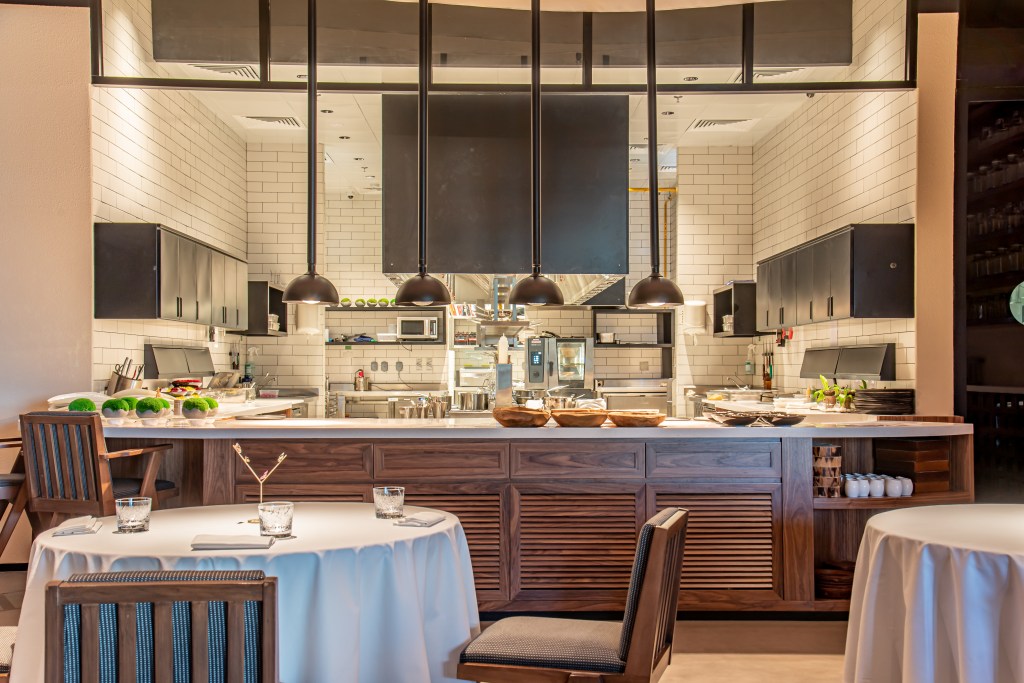
As we sit in Studio towards the end of 2024, just before the evening’s first service, he tells me now that there was a definite fear that this novel idea would not work. It’s amusing to hear that as I survey the wall littered with everything from Time Out Awards to Michelin Stars. But, having seen another famed Dubai chef try a chef’s table concept to little success around the same time as Studio launched, it was decided to minimise risk by operating the new venue as a “back door” of Tresind, in a small room just off the main restaurant.
Himanshu says: “There was always a worry that it wouldn’t do well because we used to serve tasting menus in Tresind and the percentage of a la carte was always more than the percentage of the tasting menu. I think Dubai was not ready to have tasting menus at that point of time, and during those years we had to break this notion that there could be a restaurant coming out of Dubai which is not big [in seating capacity]. Six years ago, eight years ago, there was no existing restaurant like this. Now you have Moonrise, now you have Row on 45. Now you have Orfali, which is also a small restaurant. Back in the day, every restaurant was a big restaurant.”
Of course, as the awards and accolades prove, it did well. (So well, we probably have Himanshu and team to blame for the abundance of half-baked chef’s tables around Dubai. Cheers, chef.) But, as he had anticipated, it didn’t set the heather on fire immediately. It was always going to take time to make Dubai understand this new concept, and Himanshu ended up being helped by the unlikeliest event imaginable – COVID-19. While the rest of the world huddled into bubbles and justified strict lockdowns of months at a time, Dubai welcomed guests from around the globe.
“For me, Dubai is divided into two phases,” Himanshu explains. “One is pre-Covid, one is post-Covid. Everything changed post-Covid. Dubai, as a city itself, changed a lot. It got so much exposure from the crowd who wanted to go and eat out, and they couldn’t just travel anywhere to do it. That’s when I saw so many guests come to Studio who would not come to Dubai thinking it’s a gastronomic destination.”
While Dubai was open, conditions were still challenging, so Himanshu launched a food truck-inspired menu at Studio and priced it at only 225 dirhams. Having tried that menu back then as well as Studio’s latest menus that serve at 995 dirhams, I can personally testify that the quality was almost as strong. It was truly the foodie bargain of the century – I went about five times.
“That was the moment that made everything possible for us,” says Himanshu. (Not me going five times, but the menu and the response in general.)

LEARNING FROM OTHER CHEFS
Studio’s next innovation, something which again is now commonplace at fine-dining, and even some casual restaurants, was international four-hands dinners. I’m not saying they invented chefs collaborating, I’m not mental, but again it was much rarer back in 2020 to see chefs fly in from far off destinations just for one or two nights cooking. But with Covid keeping most of the world under lock and key, Dubai had a unique opportunity and the Studio team were quick to exploit it.
“We got to cook with Ana Ros (head chef at Hisa Franko, two Michelin-starred restaurant in Slovenia) and Riccardo Camanini (of Lido 84, one Michelin-starred Italian restaurant) back to back in 20 days,” Himanshu tells me. “Getting international guests to Dubai was not something that was seen before and I think we changed that trend. It’s so important to share a kitchen with these legends because the signals you get from outside is that if a restaurant wants to do well, it needs to get expensive ingredients, but whenever I cook with any of these chefs they always told me that your strength of cooking is not in these ingredients. Your strength of cooking is in your spices, it’s in your technique to balance out the dishes. You get to realise more when you cook with chefs who have more experience than you.”
While some of Dubai’s top tasting menu restaurants like Ossiano, Moonrise and Row on 45 are renowned for their excellent use of some of the best ingredients in the world, like caviar and wagyu, Himanshu says that working with the international chefs helped inspire him to go in a different direction.
“I have not used caviar in my menu in the last four years post-Covid. I have not used a piece of wagyu in my kitchen. I want to do things differently than those around us to give a fresher perspective to our diners.”
This is the first time in six years of interviewing chefs in Dubai that I’ve heard someone discount working with the best ingredients and instead focus on spices and flavours. Indeed, just the other week, I had dinner with an international fine-dining venue owner who said they focused on extremely high-quality ingredients so they don’t need to rely on superstar chefs to make their venues pop. Of course, there is still skill required in using great ingredients, and you still need a great chef to run a high-end restaurant – like you couldn’t just put a Jamie Oliver in there and let him flail around naked or whatever he does – but you don’t need an absolutely top, top chef, like a Himanshu. This balance of ingredient-led and chef-led restaurants in Dubai may be the mythical maturity of the market that I’ve heard so much about.
SERVICE
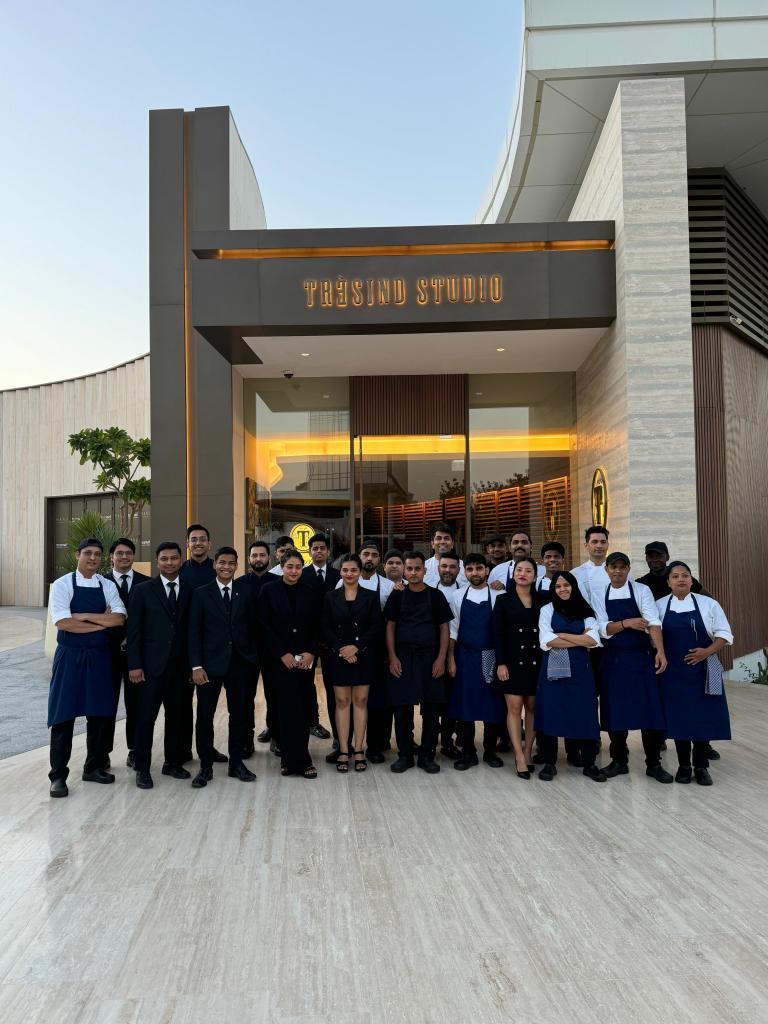
In a time when I’m personally beginning to appreciate shorter menus and fewer courses, nothing can get me out of my house quicker than the chance to dine on 20+ dishes at Tresind Studio. While this is, of course, hugely to do with the food, Studio also has a well-earned reputation for exceptional service. Led by restaurant manager Vipin Panwar, it won the Art of Hospitality award in The 50 Best’s inaugural MENA list. It’s no surprise to me. When I interviewed Himanshu six years ago, he explained his three philosophies of food, with the importance of service being the first. That hasn’t changed.
“I believe that good service can save bad food, but good food cannot save bad service,” he reaffirms. “I can be a three-star restaurant but if the service is not up to par then even a three-star dish will not taste like a three-star dish. Service is, for me, as important as food.”
Himanshu admits that when he first started cooking, more than 15 years ago, he didn’t think that was the case, believing chefs to be superstars of any restaurant and looking down on front-of-house.
“I was the first to fight with the managers or the service, and that’s all we’ve grown up seeing. You will vent your frustration on the people serving food because you think they are doing a lesser job than you, but that’s a wrong perception. They are as important as a chef in the kitchens.”
Whenever I walk into Tresind Studio, I’m greeted by Vipin who magics a Negroni (my tipple of choice, but I’m Scottish so if it has any alcohol content whatsoever, I’ll be happy with it) out of nowhere before I have the chance to realise I’m thirsty. I thought I was getting special treatment, walking around all lah-di-dah, but no, it turns out they do this for everyone, as everyone is a VIP when they step into the Studio. I’ll need to find another way to flaunt my superiority over people.

THE NEW MODERN INDIAN CUISINE
‘Modern’ is a word used a lot in my interview from six years ago. For one, it’s in the headline. And that’s because Tresind described itself as “modern Indian food” back then, but it’s a term that Himanshu wants to move away from now. As he’s matured as a chef and as a person over the past half-decade, it’s clear he’s thought a lot about his role in elevating Indian cuisine and how it’s perceived. For Himanshu, Indian food has been forward-thinking and modern for centuries, and what he’s doing now is just the next step in the evolution of Indian cuisine.
“For me, Indian food from back in the day until now is modern. There are ingredients which were never part of India but were brought to us by Portuguese and British,” Himanshu explains. “So there were no tomatoes in India, but then tomatoes were introduced by the Portuguese. Involving tomatoes in the cuisine made it modern at that point of time.”
With Himanshu stating that gorgonzola is currently one of his favourite ingredients to work with (as confirmed when it made its way into his dish at the recent, ultra-exclusive, Gault&Millau Culinary Innovators gathering of 11 of Dubai’s best chefs), he’s found a way to bring the Italian blue cheese to life in Tresind Studio. And he has no time for people who question its presence in Indian cooking.
“So people say gorgonzola is Italian; it cannot be Indian. Or galangal can only be Thai. But India has always adopted ingredients. From how Mughal influenced Indian food to how the tandoor was brought to India. I don’t want to call my food modern, I just want to call it Indian food. It’s Indian food for this generation and Indian food for the future generation because India has always adopted ingredients, India has always adopted cultures.
“Many people ask me why they see pasta on my menu? I would not say: ‘Okay recently I‘ve been to Italy and I got influenced, so there is pasta on my menu’. I grew up eating pasta. It may not be in the form of a tortellini; maybe it was instant pasta packets, but I have my association with pasta. I can’t explain it to every guest, but I always say I have grown up eating pasta, so why shouldn’t I put pasta on the menu? When an Indian questions me on this, my first answer is always that what you’re wearing is not Indian. Wearing jeans and a t-shirt was not Indian culture. So if you are evolving yourself, why do you want your cuisine to be so traditional? When everything is moving ahead with time, so should food.
“You always have to be open to positive criticism.”
Himanshu Saini
CRITICISM
With Tresind Studio holding two Michelin Stars plus all its other accolades, you’d have to imagine it has a customer base that is more worldly when it comes to food than the average restaurant diner. Its guests are people looking for an out-of-this-world experience, a meal that is “worth a detour”, as Michelin themselves put it, and are willing to spend big to get it.
But still, would I trust their opinion on the food? Of course, everyone has personal preference, and you can’t please everyone, but if I was a two-star chef recognised as one of the best in the world, would I honestly put any faith in what they said to me versus my own opinion? For me, probably not. And that’s why I’m surprised to hear Himanshu makes it his mission to find out what they didn’t like about his menu.
“You always have to be open to positive criticism,” says Himanshu. “That’s what makes you better. Every night when someone comes to eat, my first question is always, ‘What didn’t you like on the menu?’ And if somebody is not answering that, I rephrase it and ask ‘What was your least favourite dish?’ Then, eight out of 10 people would have an answer. And out of eight people, four would make sense, four would not make sense, but that is for me to decide. But then I still get so much information out of a diner. I don’t just want to go on a table and hear how amazing it was. We’ve rehearsed it so many times that we know there are amazing moments on the menu and some less amazing moments on the menu. I want to know from a guest’s point of view where they feel they are.”
As someone who has been guilty of gushing over the Tresind Studio menu and being unable to find a fault, I’ll now be thinking extra critically on my next visit so I have constructive feedback – hopefully something better than: “Well, actually, the kebab scarpetta was a bit too delicious..”. But on the other hand, there’s nothing worse than hearing some idiot who can barely cook beans on toast lecturing a Michelin-starred chef on how they “should have added a touch more cumin to that dish”. So, how do I find the right middle ground? Answers on a postcard, please.
RETIREMENT
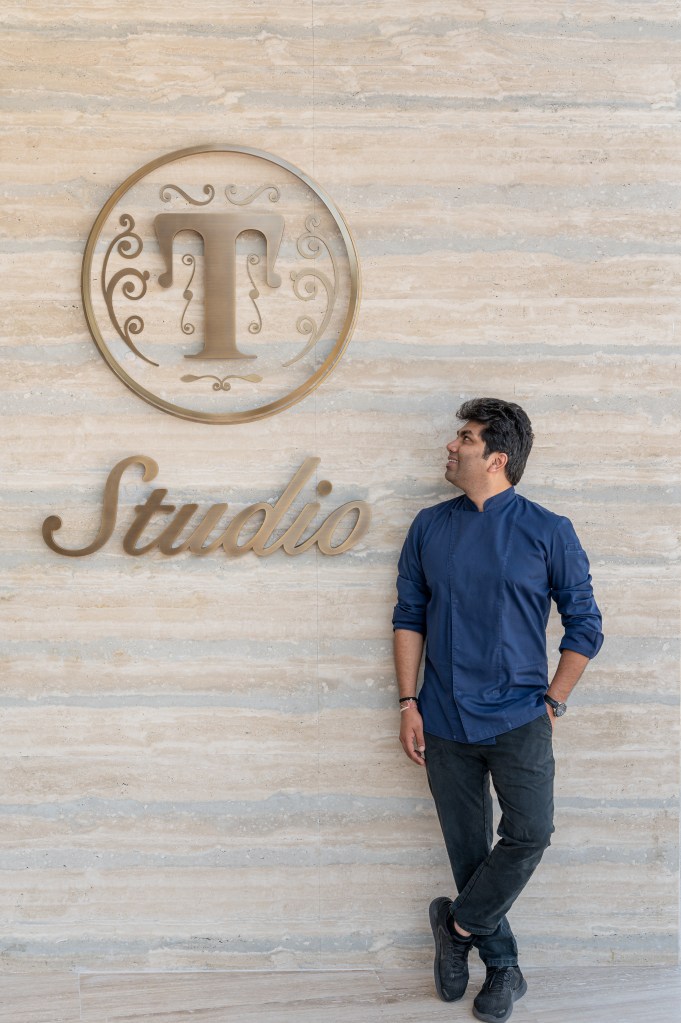
Don’t let the little sub-head above scare you, you still have time to book your seats at Tresind Studio. Himanshu isn’t going anywhere just yet. Infact there’s a lot of expansion on the cards for Passion F&B which I’m sure will be revealed soon. But when I spoke with him six years ago, even at the tender age of just 30, he already knew what his retirement plan was – to open a little restaurant near Old Trafford in Manchester and serve simple food while watching his team whenever he could. I wondered if that had changed? Six years on, would anyone still want to watch Manchester United play football? But no, that’s still the plan.
Our time together travelling down memory lane and the past six years is coming to a close as the first guests of the evening’s service enter the door. They just happen to be chefs Colin Clague and Alannah Doe, and Touch Dubai founder Jean Winter, three of Dubai’s best local talent in all their fields. And Himanshu ends on a message for supporting that kind of talent to help it achieve its goals, as the industry has done for him.
“It’s the support that has made it possible. The support you have all given me in terms of confidence, in terms of cooking, in terms of feedback. I think a lot of chefs need that support and a lot of them don’t get it. It’s very important that sometimes you go to a small restaurant where you think it has potential, it doesn’t have to be a known chef, you just have to support. If you believe in the concept, support it and see how fast it grows from there.”
What restaurant will you support this week? I’ll probably be at Studio…
Simon Ritchie is the former editor of Caterer Middle East and current comms director of Yolk Brands.
Contact editor@dishesanddrams.com for more information.


 Dishes & Drams